Gallipoli to the Somme by Alexander Aitken
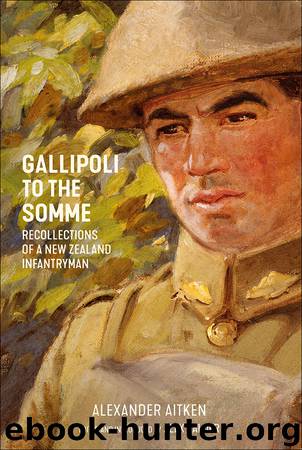
Author:Alexander Aitken
Language: eng
Format: epub
Tags: Memoir, History
Publisher: Auckland University Press
Published: 2018-12-10T16:00:00+00:00
17 Flanders to Picardy: Citernes
NEXT MORNING WE MARCHED THE FIVE MILES TO RAILHEAD AT Steenwerck, meeting further Scottish battalions on their way to Armentières. They were, I think, the Gordon Highlanders, who had suffered severely at Delville Wood; naturally no trace of this could be seen as they swung past in the kilt to the skirling of pipes. After the usual delays we entrained and moved out westwards past Hazebrouck. Unvisited Cassel, extending a little down the southern side of its commanding hill on the right, now took my eye at last, a symbol of the opportunity that does not come a second time. The journey was unexpectedly short; we stopped, still with Cassel in view only six miles behind us, at Ebblinghem, a wayside station midway between Hazebrouck and St. Omer, detrained, and marched some five miles south and west to a small sequestered village called Wardrecques, where we were quartered in the usual barns and stables.
Wardrecques was on a plateau from which the ground fell suddenly to the south-east in the direction of the low-lying ground of the Lys Canal from Aire to Merville and the front line east of Laventie. The adjacent ridge gave a view far away across a rolling plain of the country about Neuve Chapelle and La Bassée. On clear days certain faint black dots in the sky denoted observation balloons; at night we could hear a dull rumble and see distant flashes. To the far south-east, as we had noted in those early weeks, now so remote, at La Belle Hôtesse—itself only ten miles off and near enough to be visited on bicycle by a nostalgic W.O.—two slag-heaps, conspicuous as the Pyramids in a wide expanse of plain, were the only things that broke the view.1 The country about Wardrecques was very beautiful; but more than that, it had the undertones of history, for the quiet tree-shaded roads and wooded parkland where our route marches took us had known the camps and campaigns of English soldiers in those French wars of four and five hundred years before. I remember feeling this especially when passing an ancient chateau near Clarques or Thérouanne, the Terouenne of Canto VI of Scott’s Marmion, ‘where England’s king in leaguer lay’.2 All about us lay fields of good crops, ripe or overripe, standing uncut for lack of labour to cut them, a waste keenly felt by George Keith and George Norman, both farmers in my Platoon. A military order of those days invited us wherever possible to help the French to cut their crops, but since Wardrecques did not seem to have a single Frenchman left in it, and since routine gave us no unoccupied time or opportunity, this was never more than a benevolent wave of the hand. It was not yet certain in our minds whether we were really bound for the Somme; rumour, whose tongue had been much less insistent on the French front than in the unimaginably far-off days of the Levant, had suggested that
Download
This site does not store any files on its server. We only index and link to content provided by other sites. Please contact the content providers to delete copyright contents if any and email us, we'll remove relevant links or contents immediately.
Fanny Burney by Claire Harman(26607)
Empire of the Sikhs by Patwant Singh(23090)
Out of India by Michael Foss(16861)
Leonardo da Vinci by Walter Isaacson(13341)
Small Great Things by Jodi Picoult(7156)
The Six Wives Of Henry VIII (WOMEN IN HISTORY) by Fraser Antonia(5519)
The Wind in My Hair by Masih Alinejad(5103)
A Higher Loyalty: Truth, Lies, and Leadership by James Comey(4967)
The Crown by Robert Lacey(4821)
The Lonely City by Olivia Laing(4808)
Millionaire: The Philanderer, Gambler, and Duelist Who Invented Modern Finance by Janet Gleeson(4482)
The Iron Duke by The Iron Duke(4367)
Papillon (English) by Henri Charrière(4278)
Sticky Fingers by Joe Hagan(4207)
Joan of Arc by Mary Gordon(4117)
Alive: The Story of the Andes Survivors by Piers Paul Read(4037)
Stalin by Stephen Kotkin(3973)
Aleister Crowley: The Biography by Tobias Churton(3646)
Ants Among Elephants by Sujatha Gidla(3470)
